Negation in Arabic: How to Say No and Not
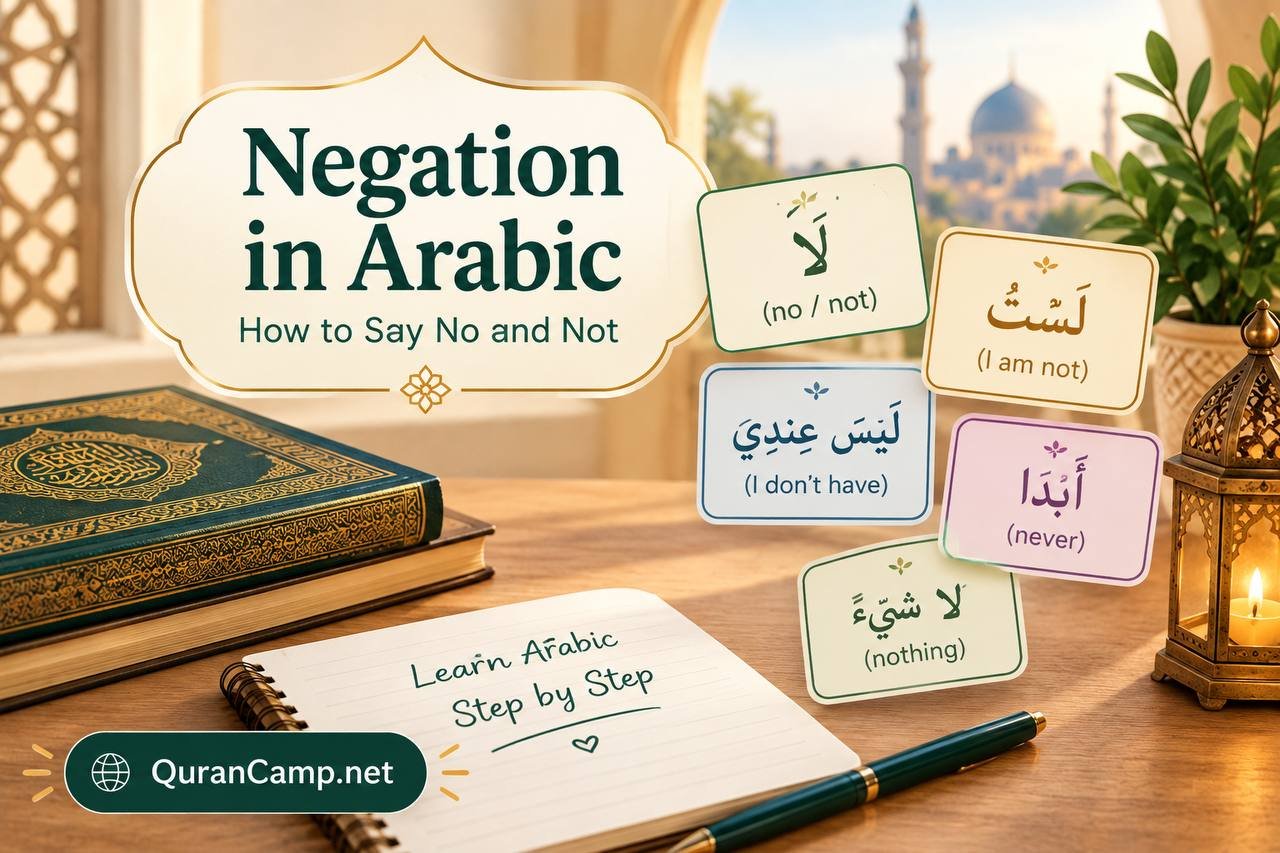
Learning how to say no and not is an important step when learning Arabic. Whether you want to say “I don’t understand,” “I am not tired,” or “I don’t have a book,” Arabic has several simple ways to express negative meanings.
In this lesson, you’ll learn some of the most common Arabic negation words and how to use them in everyday conversations.
1. How to Say “No” in Arabic
The Arabic word for “no” is لَا (lā).
You can use it to answer a question with a simple “no.”
Example:
هَلْ أَنْتَ طَالِبٌ؟
Hal anta ṭālib?
Are you a student? (To a male)
لَا.
Lā.
No.
You can also use لَا to make certain sentences negative, as you’ll see below.
2. How to Say “Don’t” or “Do Not” in Arabic
In everyday Arabic, the word لَا (lā) can be used before a present-tense verb to make a negative sentence.
Look at these examples:
Affirmative:
أَفْهَمُ
Afhamu.
I understand.
Negative:
لَا أَفْهَمُ
Lā afhamu.
I don’t understand.
Here is another example:
Affirmative:
أَتَكَلَّمُ الْعَرَبِيَّةَ
Atakallamu al-ʿarabiyyah.
I speak Arabic.
Negative:
لَا أَتَكَلَّمُ الْعَرَبِيَّةَ
Lā atakallamu al-ʿarabiyyah.
I don’t speak Arabic.
Notice how the word لَا comes before the verb to make the sentence negative.
3. How to Say “I Am Not” in Arabic
In the present tense, Arabic often expresses meanings such as “I am happy” or “She is tired” without using a separate word for “am” or “is.”
To make these sentences negative, we commonly use لَسْتُ (lastu), meaning “I am not.”
Affirmative:
أَنَا سَعِيدٌ
Anā saʿīd.
I am happy. (A male speaker)
Negative:
أَنَا لَسْتُ سَعِيدًا
Anā lastu saʿīdan.
I am not happy. (A male speaker)
For a female speaker, you can say:
أَنَا لَسْتُ سَعِيدَةً
Anā lastu saʿīdatan.
I am not happy. (A female speaker)
Here is another useful example:
أَنَا لَسْتُ مُتْعَبًا
Anā lastu mutʿaban.
I am not tired. (A male speaker)
أَنَا لَسْتُ مُتْعَبَةً
Anā lastu mutʿabatan.
I am not tired. (A female speaker)
4. How to Say “I Don’t Have” in Arabic
To express “I don’t have” in Arabic, you can use لَيْسَ عِنْدِي (laysa ʿindī).
For example:
عِنْدِي كِتَابٌ
ʿIndī kitābun.
I have a book.
لَيْسَ عِنْدِي كِتَابٌ
Laysa ʿindī kitābun.
I don’t have a book.
You can use this expression in many everyday situations.
لَيْسَ عِنْدِي وَقْتٌ
Laysa ʿindī waqtun.
I don’t have time.
لَيْسَ عِنْدِي سُؤَالٌ
Laysa ʿindī suʾālun.
I don’t have a question.
In everyday spoken Arabic, people may use different expressions depending on their dialect.
5. How to Say “Never” and “Nothing” in Arabic
Arabic has other useful words for expressing negative meanings.
أَبَدًا (abadan) — Never
This word can mean “never,” depending on the sentence.
لَنْ أَفْعَلَ ذَلِكَ أَبَدًا.
Lan afʿala dhālika abadan.
I will never do that.
لَا شَيْءَ (lā shayʾ) — Nothing
This expression means “nothing.”
مَاذَا تُرِيدُ؟
Mādhā turīd?
What do you want? (To a male)
لَا شَيْءَ.
Lā shayʾ.
Nothing.
لَا أَحَدَ (lā aḥada) — Nobody
This expression can mean “nobody” or “no one,” depending on the sentence.
For example:
لَا أَحَدَ هُنَا.
Lā aḥada hunā.
There is nobody here.
6. Practice Arabic Negation
Let’s practice with a few simple questions and answers.
Question 1:
هَلْ تَفْهَمُ الْعَرَبِيَّةَ؟
Hal tafhamu al-ʿarabiyyah?
Do you understand Arabic? (To a male)
Answer:
لَا، لَا أَفْهَمُ الْعَرَبِيَّةَ جَيِّدًا.
Lā, lā afhamu al-ʿarabiyyata jayyidan.
No, I don’t understand Arabic well.
Question 2:
هَلْ أَنْتَ مُتْعَبٌ؟
Hal anta mutʿab?
Are you tired? (To a male)
Answer:
لَا، لَسْتُ مُتْعَبًا.
Lā, lastu mutʿaban.
No, I am not tired.
Question 3:
هَلْ عِنْدَكَ كِتَابٌ؟
Hal ʿindaka kitābun?
Do you have a book? (To a male)
Answer:
لَا، لَيْسَ عِنْدِي كِتَابٌ.
Lā, laysa ʿindī kitābun.
No, I don’t have a book.
Conclusion
Learning negation will help you communicate more confidently in Arabic. Start by practicing a few useful expressions, such as لَا (no/not), لَسْتُ (I am not), and لَيْسَ عِنْدِي (I don’t have).
As you continue learning, you’ll discover that choosing the right negative word depends on the meaning and structure of the sentence.
Want to learn Arabic step by step? Explore more Arabic learning resources at Quran Camp and continue building your vocabulary through simple, practical lessons.

You may also like

A Gentle Wake-Up Call for Your Heart: Finding Your Way Back to Allah