Arabic-Speaking Countries: Names, Populations, and Languages
Arabic is one of the world’s most widely spoken languages, connecting hundreds of millions of people across the Middle East, North Africa, and communities around the globe. It is also the language of the Quran, making it especially important to Muslims who wish to understand the words of Allah in their original language.
But how many Arabic-speaking countries are there? What are their names and populations? And do people in all these countries speak Arabic in the same way?
In this guide, we will explore the 22 countries of the Arab League, their capitals, approximate populations, and the main Arabic dialects spoken across the Arab world. We will also look at the difference between everyday Arabic and Quranic Arabic and explain how learning Arabic can help you connect with a rich linguistic, cultural, and religious heritage.
How Many Arabic-Speaking Countries Are There?
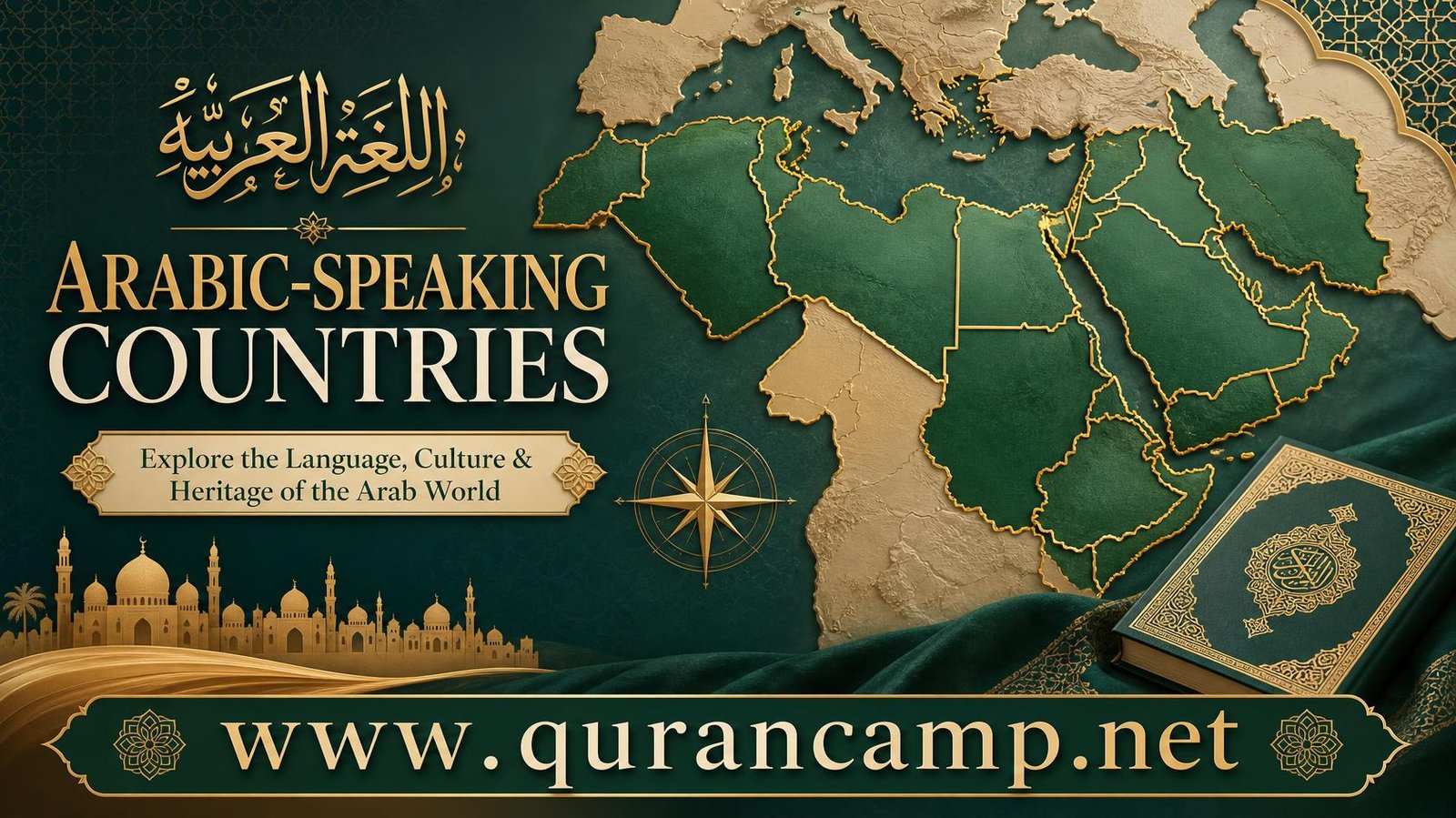
There are 22 member states of the Arab League, stretching from North Africa to the Arabian Peninsula and the Middle East.
Arabic is an official language throughout this region, although other languages are also widely spoken in some countries. These include Amazigh languages in North Africa, Kurdish in Iraq, Somali in Somalia, and Comorian in the Comoros.
The Arab world is home to a wide variety of cultures and traditions. Although its countries share the Arabic language, each has its own history, local expressions, and spoken dialects.
For learners who want to develop their Arabic skills, understanding these differences is an excellent starting point.
The 22 Arabic-Speaking Countries and Their Populations
The following list presents the 22 Arab League member states, their capitals, approximate populations, and some information about the Arabic spoken in each country.
Important: Population figures are approximate estimates for 2025 and are rounded for readability. Actual figures vary by source and reference date. The population of a country should not be confused with the number of people who speak Arabic as their first language.
1. Egypt
Capital: Cairo
Population: Approximately 118 million
Egypt is the most populous country in the Arab world. Egyptian Arabic is widely recognized throughout the Middle East and North Africa, partly because Egyptian films, television programs, and music have reached audiences across the region.
Egypt also has a long history of Arabic literature, Islamic scholarship, and education. Al-Azhar, located in Cairo, is one of the world’s most prominent institutions for Islamic learning.
For Muslims who want to understand the Quran, learning Arabic can provide a deeper connection with its original words and expressions.
2. Sudan
Capital: Khartoum
Population: Approximately 52 million
Sudan is located in northeastern Africa. Sudanese Arabic is widely spoken, alongside numerous other languages used by the country’s diverse communities.
Sudanese Arabic has distinctive expressions and pronunciation influenced by the country’s history and cultural connections with both Africa and the Arab world.
3. Algeria
Capital: Algiers
Population: Approximately 47 million
Algeria is the largest country in Africa by land area. Arabic and Amazigh are its official languages.
Algerian Arabic is commonly used in everyday conversations, while Modern Standard Arabic is used in formal writing, education, and official communication. French is also widely used in certain professional and educational settings.
4. Iraq
Capital: Baghdad
Population: Approximately 47 million
Iraq is home to one of the world’s oldest civilizations, ancient Mesopotamia.
Arabic is an official language alongside Kurdish. Iraqi Arabic has distinctive vocabulary, expressions, and pronunciation that distinguish it from other regional dialects.
Iraq has also played an important role in the history of Arabic literature, language, and Islamic scholarship.
5. Yemen
Capital: Sana’a
Population: Approximately 42 million
Yemen is located in the southern part of the Arabian Peninsula.
Arabic is the official language, and several regional varieties of Yemeni Arabic are spoken throughout the country.
Yemen is known for its historic cities, traditional architecture, and rich cultural heritage.
6. Saudi Arabia
Capital: Riyadh
Population: Approximately 37 million
Saudi Arabia occupies most of the Arabian Peninsula and is home to Mecca and Medina, the two holiest cities in Islam.
Arabic is the official language, and the country has several regional dialects, including Najdi and Hijazi Arabic.
Saudi Arabia holds a special place in the hearts of Muslims because of its connection with the Quran and the Prophet Muhammad (peace and blessings be upon him).
Learning Arabic can help Muslims understand Quranic vocabulary and expressions more deeply. If you would like to develop your understanding of the Quran, explore the online Quran and Arabic learning programs at QuranCamp.
7. Morocco
Capital: Rabat
Population: Approximately 38 million
Morocco is located in northwestern Africa. Arabic and Amazigh are its official languages.
Moroccan Arabic, commonly called Darija, is widely spoken in everyday life. Its vocabulary and pronunciation differ from those of many Middle Eastern dialects, and French is also used in some educational and professional settings.
Morocco’s linguistic diversity reflects its long history and its connections with North Africa, Europe, and the wider Arab world.
8. Syria
Capital: Damascus
Population: Approximately 26 million
Syria has a long history of trade, education, and cultural exchange.
Arabic is the official language, and Syrian Arabic belongs to the Levantine dialect group. It shares many features with the dialects spoken in Lebanon, Palestine, and Jordan.
Damascus is one of the region’s historic cities, known for its cultural, architectural, and religious heritage.
9. Somalia
Capital: Mogadishu
Population: Approximately 20 million
Somalia is located in the Horn of Africa. Somali is the country’s main language, while Arabic is also an official language.
Arabic has an important role in religious education and Islamic studies, reflecting Somalia’s longstanding connections with the wider Muslim world.
10. Tunisia
Capital: Tunis
Population: Approximately 12 million
Tunisia is a North African country with a rich history influenced by Arab, Amazigh, Mediterranean, and other cultures.
Arabic is the official language, and Tunisian Arabic is widely used in everyday communication. Modern Standard Arabic is used in formal contexts, while French is also used in certain professional and educational settings.
11. Jordan
Capital: Amman
Population: Approximately 11.5 million
Jordan is located in the Levant. Arabic is its official language, and Jordanian Arabic belongs to the Levantine dialect group.
Jordan shares many linguistic and cultural connections with neighboring Palestine, Syria, and Lebanon.
The country is also known for historical sites such as Petra and its rich cultural heritage.
12. United Arab Emirates
Capital: Abu Dhabi
Population: Approximately 11.5 million
The United Arab Emirates is a federation of seven emirates. Arabic is the official language, and Emirati Arabic is spoken in local communities.
The UAE is also home to a large international population, so English and many other languages are widely used in everyday life.
13. Libya
Capital: Tripoli
Population: Approximately 7.5 million
Libya is located in North Africa along the Mediterranean coast. Arabic is the official language, and Libyan Arabic is widely spoken.
Libyan Arabic has features influenced by both eastern and western North African dialects.
The country’s history reflects its connections with the Mediterranean, North Africa, and the wider Arab world.
14. Lebanon
Capital: Beirut
Population: Approximately 5.8 million
Lebanon is a country on the eastern Mediterranean coast. Arabic is the official language, and Lebanese Arabic is commonly spoken.
French and English are also used by many people, particularly in education, business, and media.
Lebanon is known for its cultural diversity, literature, music, and distinctive cuisine.
15. Mauritania
Capital: Nouakchott
Population: Approximately 5.3 million
Mauritania is located in northwestern Africa. Arabic is its official language, and Hassaniya Arabic is widely spoken.
The country combines Arab and African cultural influences and has a long tradition of Islamic scholarship.
16. Oman
Capital: Muscat
Population: Approximately 5.5 million
Oman is located on the southeastern coast of the Arabian Peninsula. Arabic is the official language, and Omani Arabic includes several regional varieties.
Oman is known for its maritime history, traditional architecture, and distinctive cultural heritage.
17. Kuwait
Capital: Kuwait City
Population: Approximately 4.9 million
Kuwait is located on the Arabian Gulf. Arabic is the official language, and Kuwaiti Arabic is commonly used in everyday conversations.
The country has a rich history of trade, seafaring, and cultural exchange with neighboring Gulf communities.
18. Qatar
Capital: Doha
Population: Approximately 3 million
Qatar is a country on the Arabian Peninsula. Arabic is its official language, and Qatari Arabic is spoken in local communities.
Qatar has developed into an international center for education, media, business, and sports. Its population also includes people from many linguistic backgrounds.
19. Bahrain
Capital: Manama
Population: Approximately 1.6 million
Bahrain is an island country in the Arabian Gulf. Arabic is the official language, and Bahraini Arabic is widely spoken.
Its history includes pearl diving, maritime trade, and longstanding connections with other Gulf countries.
20. Djibouti
Capital: Djibouti City
Population: Approximately 1.2 million
Djibouti is located in the Horn of Africa, near the Red Sea. Arabic and French are official languages, while Somali and Afar are widely spoken.
Arabic has an important role in religious and cultural life, reflecting Djibouti’s connections with the Arab world.
21. Comoros
Capital: Moroni
Population: Approximately 883,000
The Comoros is an island country in the Indian Ocean. Its official languages are Comorian, Arabic, and French.
Comorian is widely spoken in everyday life, while Arabic is important in religious education and Islamic traditions.
22. Palestine
Capital: East Jerusalem is claimed as its capital; Ramallah serves as an administrative center.
Population: Approximately 5.4 million in the Palestinian territories, based on some 2025 estimates.
Arabic is the main language spoken by Palestinians. Palestinian Arabic belongs to the Levantine dialect group and shares many features with Jordanian, Lebanese, and Syrian Arabic.
It also has its own expressions, vocabulary, and regional variations.
Palestine has a rich linguistic, cultural, and religious heritage, and Arabic remains central to Palestinian identity and daily life.
Population note: Population estimates for Palestine and other countries may differ according to the source, date, and geographic coverage used.
How Many People Speak Arabic Worldwide?
Arabic is spoken by hundreds of millions of people around the world.
The combined population of the 22 Arab League countries is approximately half a billion people, although not everyone in these countries speaks Arabic as their first language.
Arabic is also spoken by communities living outside the Arab world, including people in Europe, North America, South America, and other regions.
It is important to distinguish between the population of Arabic-speaking countries and the total number of Arabic speakers worldwide. These are related but different measurements.
Arabic is also one of the six official languages of the United Nations, reflecting its international importance.
Are All Arabic Dialects the Same?
No. Arabic has many regional dialects, and everyday speech can differ considerably from one country to another.
Here are some of the major dialect groups.
Egyptian Arabic
Egyptian Arabic is spoken in Egypt and is widely recognized throughout the Arab world because of the country’s influential entertainment industry.
Levantine Arabic
Levantine Arabic includes dialects spoken in Palestine, Jordan, Lebanon, and Syria. These varieties share many expressions and grammatical features, although differences remain between countries and communities.
Gulf Arabic
Gulf Arabic includes varieties spoken in Saudi Arabia, Kuwait, Bahrain, Qatar, the United Arab Emirates, and other Gulf communities.
Maghrebi Arabic
Maghrebi Arabic includes varieties spoken in Morocco, Algeria, Tunisia, and Libya. Some of these dialects have vocabulary influenced by Amazigh, French, and other languages.
Sudanese Arabic
Sudanese Arabic is widely spoken in Sudan and has distinctive vocabulary, pronunciation, and expressions.
Yemeni Arabic
Yemeni Arabic includes several regional varieties, reflecting the country’s diverse geography and cultural history.
Hassaniya Arabic
Hassaniya Arabic is spoken in Mauritania and parts of the wider Sahara region.
Although these dialects differ, Modern Standard Arabic provides a common language for formal writing, education, literature, and official communication throughout the Arab world.
What Is the Difference Between Modern Standard Arabic and Quranic Arabic?
Modern Standard Arabic is used in contemporary formal writing, education, news broadcasts, and official communication.
Quranic Arabic refers to the Arabic of the Quran. Studying it helps learners understand the vocabulary, grammatical structures, expressions, and meanings found in the Quranic text.
The two forms are closely related, but learning everyday conversational Arabic alone does not automatically provide a complete understanding of the Quran.
For Muslims who want to understand the Quran directly, studying Arabic grammar, vocabulary, and Quranic expressions can be especially beneficial.
How Can Beginners Start Learning to Read Arabic?
For many beginners, the first step is learning to recognize Arabic letters and their different shapes. Students then progress to joining letters, reading words, and practicing complete sentences.
A structured learning method can make this process easier, particularly for children and learners who have never studied Arabic before.
At QuranCamp, beginners can explore our guide to understanding the Noor Al Bayan method, which explains how this method supports Arabic reading and Quranic reading skills.
If you are looking for a structured program, you can also explore our Noor Al Bayan Quran-reading course for adults and teenagers.
Parents who want their children to build a strong foundation can learn more about our Noor Al Bayan course for children.
Why Learn Arabic?
There are many reasons to learn Arabic, whether you are interested in religion, culture, travel, education, or communication.
1. Understand the Quran
Arabic is the language of the Quran. Learning it can help Muslims appreciate the meanings and expressions of the Quran in its original language.
2. Communicate with Arabic Speakers
Learning Arabic can help you communicate with people from different countries and cultural backgrounds. It can also make travel and cultural exchange more rewarding.
3. Explore Arab Culture
Arabic opens the door to a rich heritage of literature, poetry, history, storytelling, and traditions.
4. Support Your Children’s Education
Introducing children to Arabic at an early age can help them develop familiarity with the language and prepare them for further learning.
At QuranCamp, children can begin with engaging, age-appropriate lessons through our Arabic course for kids using visuals and sounds.
5. Develop New Opportunities
Arabic can be useful in education, translation, business, research, international communication, and many other fields.
Whatever your reason for learning Arabic, a clear learning plan and regular practice can help you make steady progress.
Learn Arabic and the Quran Online with QuranCamp
Learning Arabic is more than memorizing words and grammar.
It is an opportunity to discover a rich language, connect with different cultures, and develop a deeper understanding of the Quran.
Whether you are a complete beginner, an adult returning to Arabic after many years, or a parent looking for lessons for your child, choosing the right learning program can make a meaningful difference.
At QuranCamp, we offer online learning opportunities in Arabic, Quran reading, Quran recitation, and Islamic studies for children and adults.
Our lessons are delivered online, allowing students to learn with qualified teachers and arrange a schedule that suits their needs.
You can explore our online Arabic and Quran learning programs to discover the available options.
If you are ready to begin, visit QuranCamp and request a free trial session. Take the first step toward learning Arabic and building a stronger connection with the Quran.
Learn Arabic. Understand the Quran. Discover the richness of the Arabic language.
Visit QuranCamp.net to explore our courses and educational resources.

You may also like

A Gentle Wake-Up Call for Your Heart: Finding Your Way Back to Allah
Manazil al-Sa’irin: A Journey to a Better Heart