
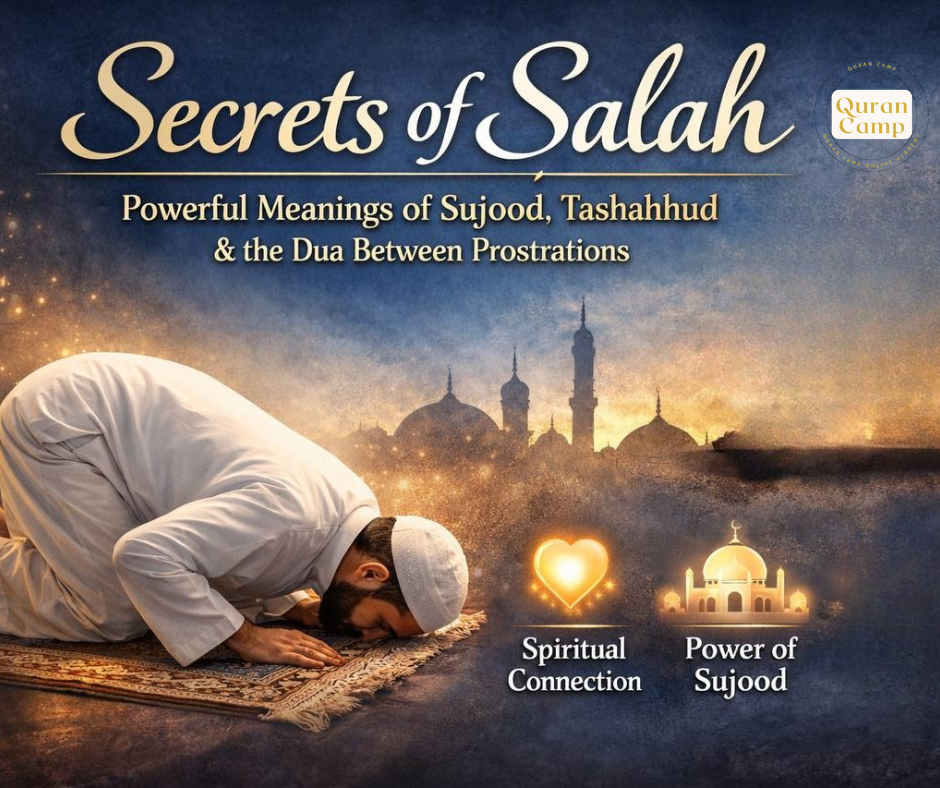
Secrets of Salah 10: Powerful Meanings of Sujood, Tashahhud, and the Dua Between Prostrations
we will explore powerful meanings behind the supplication between the two prostrations, the wisdom of repeated prostrations, and the words of Attashahud.
The Powerful Supplication Between the Two Prostrations
Between the two prostrations, Muslims recite a short but comprehensive dua:
“O Allah, forgive me, have mercy on me, guide me, grant me well-being, and provide for me.”
These five requests are not random—they include everything a person needs in both this life and the Hereafter.
Provision (Rizq)
Provision is not only money or a job. The greatest provision is spiritual:
• Praying Fajr on time
• Praying at night (Qiyam)
• Feeling closeness to Allah
A strong heart connected to Allah is the greatest form of wealth.
Well-being (Afiyah)
Well-being means protection from harm—both in life and the Hereafter. It includes:
• Physical health
• Emotional peace
• Protection from sins and punishment
Guidance (Hidayah)
Guidance has two levels:
• Knowing the truth
• Being able to follow it
A person needs both. Knowing what is right is not enough without the strength to act upon it.
Forgiveness (Maghfirah)
The root meaning of forgiveness is “to cover and protect.”
Just like a helmet protects the head, Allah’s forgiveness:
• Covers sins
• Shields the believer from punishment
Mercy (Rahmah)
Mercy is a comprehensive word that includes all goodness:
• Receiving blessings
• Being protected from harm
It is the umbrella that gathers all Khayr.
Why Do We Prostrate Twice in Every Rak‘ah?
Sujood (prostration) is repeated twice in every unit of prayer—and this is not without wisdom.
The Closest Moment to Allah
Prostration is the highest spiritual state:
• The body is at its lowest position
• The heart is at its highest level of humility
It is the moment when a servant is closest to Allah.
Preparation for the Meeting
Everything before sujood—standing and bowing—is like preparation.
Sujood is the moment of closeness and connection.
Nourishment for the Soul
Just like the body eats bite by bite, the soul is nourished gradually:
• Each movement in prayer feeds the heart
• Repetition strengthens spiritual impact
Cleansing the Heart
Prayer acts like a purification process:
• It washes away sins
• It cleans the heart daily
The five daily prayers equal 17 obligatory Rakaat, like 17 daily “cleanses” for the heart.
The Meaning of Tashahhud (Final Sitting)
At the end of prayer, the believer sits and speaks words of praise and devotion.
“At-Tahiyyat” (All Greetings)
All forms of honor, respect, and sovereignty belong only to Allah.
“As-Salawat”
All acts of worship are sincerely for Allah alone.
“At-Tayyibat” (All Good Things)
Allah is pure and only accepts what is pure:
• Pure words
• Pure actions
• Pure intentions
Paradise itself is pure because it is from Him.
The Four Powerful Words
The prayer concludes with words that carry deep meanings:
• SubhanAllah → Allah is free from all نقص (imperfection)
• Alhamdulillah → All praise belongs to Him for His perfection
• La ilaha illa Allah → None deserves worship except Him
• Allahu Akbar → Allah is greater than everything
These words combine:
• Declaring Allah’s perfection
• Affirming His greatness
• Strengthening faith in the heart.
Final Reflection
When we understand what we say in prayer, Salah becomes more than a routine—it becomes a powerful spiritual experience.
Every word, every movement, and every moment in prayer is an opportunity:
• To reconnect with Allah
• To purify the heart
• To find peace and purpose

You may also like

Compete for the Hereafter, Not the World

Egyptian Culture: 10 Traditions Every Visitor Should Know